

The Australian and New Zealand Standard Classification of Occupations (ANZSCO) code for Australian Visas & Immigration.
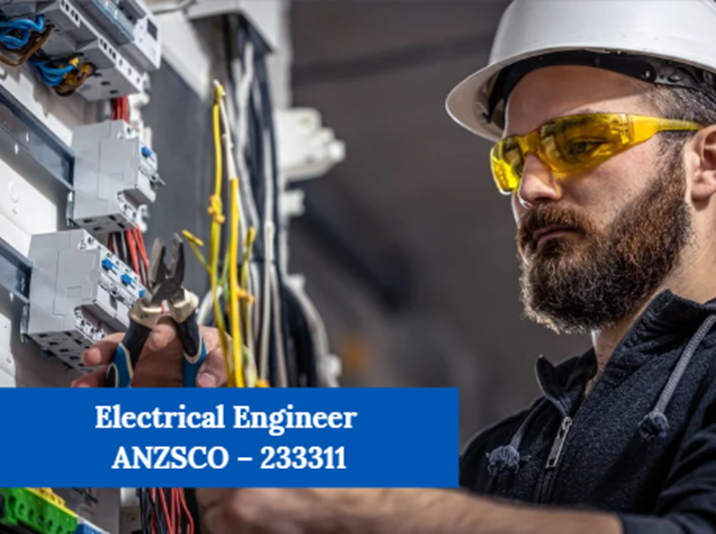
ANZSCO 233311 Electrical Engineer
An electrical engineer designs equipment, machines, and systems for the generation, distribution, utilization, and control of electric power, as well as oversees their installation, operation, and maintenance. A license or registration may be required.
Skill Level
In Australia and New Zealand:
Most occupations in this unit group have a level of skill commensurate with a bachelor degree or higher qualification. In some instances relevant experience and/or on-the-job training may be required in addition to the formal qualification (ANZSCO Skill Level 1).
Specialisations
- Electrical Design Engineer
- Railway Signalling Engineer
- Signalling and Communications Engineer
Skills assessment for Electrical Engineers
Each year, the Department of Immigration and Border Protection (DIBP) in Australia publishes a list of professions that require skilled migrants from all over the world. A skilled and experienced Electrical Engineer should take full advantage of the opportunity to apply for one such post, making room for a lucrative career in Australia. Under the 233311 electrical engineer CDR sample, Skill Level 1, you can move to the country using your relevant skills.
A Competency Demonstration Report is a medium by which engineers aspiring to obtain an Australia Skilled Migration Visa will show their capability. The Australian Engineers, popularly known as the EA, is the reviewing body for all skilled immigration applications in Australia and stipulates a few requirements for the preparation of an engineering study.
Engineers Australia requires you to write your own CDR Sample for Electrical Engineering and show the technological knowledge and communication skills at the same time to prove their flexibility and capabilities.
Electrical Engineer job description, duties and education requirements
- Planning and designing power stations and power generation equipment
- Determining the type and arrangement of circuits, transformers, circuit-breakers, transmission lines and other equipment
- Developing products such as electric motors, components, equipment and appliances
- Interpreting specifications, drawings, standards and regulations relating to electric power equipment and use
- Organising and managing resources used in the supply of electrical components, machines, appliances and equipment
- Establishing delivery and installation schedules for machines, switchgear, cables and fittings
- Supervising the operation and maintenance of power stations, transmission and distribution systems and industrial plants
- Designing and installing control and signalling equipment for road, rail and air traffic
- May specialize in research in areas such as power generation and transmission systems, transformers, switchgear and electric motors, telemetry and control systems