

The Australian and New Zealand Standard Classification of Occupations (ANZSCO) code for Australian Visas & Immigration.
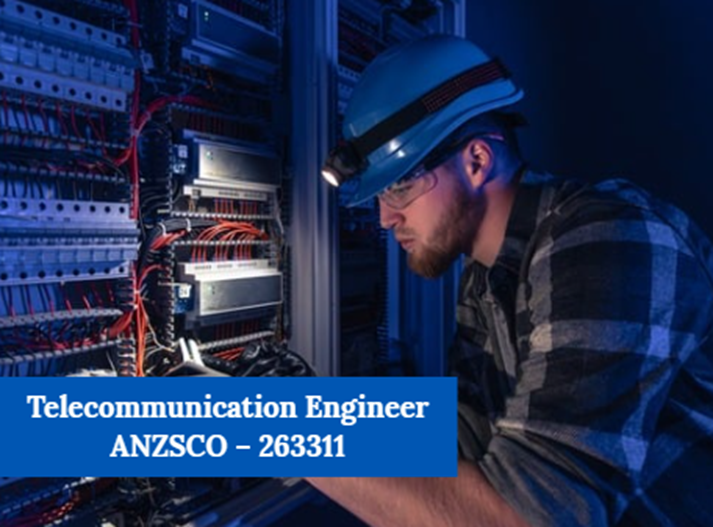
ANZSCO 263311 Telecommunication Engineer
A Telecommunications Engineer designs and develops telecommunications systems, devices, and products. The specialists also integrate network and telecommunications technologies with computer software, hardware, desktops, peripherals, databases, and operating systems. A license or registration may be required.
Skill Level
In Australia and New Zealand:
Most occupations in this unit group have a level of skill commensurate with a bachelor degree or higher qualification. At least five years of relevant experience and/or relevant vendor certification may substitute for the formal qualification. In some instances relevant experience and/or on-the-job training may be required in addition to the formal qualification (ANZSCO Skill Level 1).
Specialisations
- Signals Officer (Army) (NZ) (S)
Skills assessment for Telecommunication Engineers
Immigrants who have successfully completed telecommunication engineering from reputable courses of engineering would be interested in getting high pay jobs in Australia. Migrants willing to enter Australia for higher education or career purposes will strive to write detailed Telecommunication Engineer CDR’s without making unforced mistakes. When they submit technical reports according to Engineers Australia (EA) specifications, migrants will be accepted to one of the reputed engineering courses or businesses.
CDR (Competency Demonstration Report) is a report of technical competence sent to the EA by migrants for their perusal and approval. If the aspirants have written copy scape or rich content plagiarism, EAs will immediately reject the CDR. Before submitting the same to EA, candidates who are seriously planning to enter Australia for educational and career purposes should review the materials several times.
EA is a professional organization run by a senior engineering team. This organization has thousands of members who undertake a lot of work. One of the tasks assigned to these senior engineers is to correct and accept technical reports. Candidates who intend to enter Australia seriously will strive to write an exhaustive, detailed, and concise technical report based on the latest MSA booklet and other requirements. The engineers can take references from CDR samples of telecommunication engineers to prepare a perfect CDR report.
Telecommunication Engineer job description, duties and education requirements
- Compilation of proposals for engineering projects to specify priorities, identify scope, meaning and requirement, and decide the cost of equipment, materials and services
- Telecommunications infrastructure, networks and services, such as speech, radio, two-way, data, microwave, satellite and digital data systems, are planned, built, installed, configured and commissioned and ensure the interconnection of telecommunications systems with equipment from various vendors, service providers and users
- Assessing and purchasing new goods and services from manufacturers
- The identification and creation of new telecommunications sites through the location of sites, the filing of papers, the drawing up of approval documents, the drafting of building plans and the resulting approval
- Ensuring consistency in the provision of telecommunications systems with rules, legislation, policies and procedures
- Determining suitable hardware and software specifications for telecommunications, ensuring the desired efficiency of telecommunications equipment
- Determination of the type and configuration of circuits, transformers, circuit breakers, lines and facilities for the transmission
- Preparation and analysis of standards, sketches and rules regarding the use of telecommunications equipment
- Telecommunications monitoring systems to evaluate the need for changes, enhancements, modifications, proactive maintenance and new systems.
- infrastructure improvement strategies, incorporating features, upgrading existing networks and delivering enhanced telecommunications.
- Evaluating system hardware and software efficiency standards to predict potential requirements, and designing short- and long-term